
What is Dimensional Weight and How is it Calculated?
Oct 1st 2025
If you’ve ever shipped a large but lightweight package and thought, “Why does this cost so much?”, the answer probably lies in something called dimensional weight.
Whether you run an eCommerce store, distribution center, manage logistics, or ship products regularly, understanding how dimensional weight works can help you cut down on unnecessary shipping costs.
What Is Dimensional Weight?
Dimensional weight, also called DIM weight, is a pricing method used by shipping carriers like FedEx, UPS, DHL, and USPS to account for the space a package takes up, not just its weight.
Instead of charging solely based on actual weight, carriers calculate both:
- The actual weight -what the package weighs on shipping scales, and
- The dimensional weight - based on volume using the dimensions of the package
The shipping carrier charges the higher of the two and this becomes your billable weight.
Why Do Shipping Carriers Use DIM Weight?
This method ensures carriers make the most efficient use of their trucks, planes, and warehouses.
Imagine you’re shipping 20 large boxes full of ornamental feathers. They weigh almost nothing, but they take up a ton of room in a delivery truck. If the carrier charged you based strictly on weight, they’d lose money because they can fit less packages in the truck due to your box sizes.
Instead, they calculate dimensional weight to charge more fairly for large, lightweight packages. So, why do shipping carriers use this rate calculation method?
- Maximize vehicle space
- Reduce undercharged shipments
- Encourage smarter packaging
- Lower carbon footprint by cutting shipping volume
How to Calculate Dimensional Weight
To calculate DIM weight, carriers use this simple formula: Length x Width x Height / DIM Divisor = Dimensional weight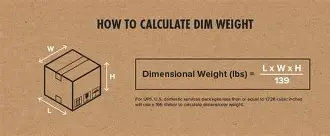
Step-by-step:
-
Measure your package in inches
-
Multiply Length × Width × Height
-
Divide that number by the DIM divisor (check with your carrier)
-
Round up to the next full pound
Example:
A box that’s 20" x 15" x 10": (20 x 15 x 10) / 139 = 21.6 lbs.
Billable weight, rounded to the nearest pound: 22 lbs
If the actual weight is only 12 lbs, the carrier will charge for 22 lbs because the dimensional weight is higher.
Does Weight Really Matter with DIM Weight?
Let’s imagine you’re shipping 20 smaller boxes full of 10 lb bowling balls. These are heavier, but the box size is much smaller. The carrier can fit many more of these in their truck than the boxes of feathers. So cost should be less, right? Not necessarily.
While the boxes are smaller, they’re also heavier. Weight is another factor in shipping because of weight limitations for freight, delivery trucks, and additional modes of transport. This is why carriers have a weight limit for packages that can be shipped via standard ground services. Once the weight limit is exceeded, they generally require shipping via larger trucks, or LTL freight.
So the answer to the question is yes. Although shipments are largely influenced by dimensional size, weight is also an important part of the equation when alculating freight rates. This is why it is important to use accurate shipping scales. Inaccurate weights can be detrimental to your bottom line as a result of miscalculating freight rates.