
What Are Load Cells and How Do They Work?
Posted by Taylor on Mar 18th 2026
Load cells appear in nearly every industry that needs accurate force or weight measurement, yet they’re so discreet that most people never notice them. Whether its in a price-computing scale at the grocery store, in a conveyor scale in a busy warehouse, or in your humble bathroom scale at home, the load cell is quietly at work doing the math.
In this blog, we’ll walk through a step by step process on what a load cell is, how they work, and why their design is so reliable.
What is a Load Cell?
A load cell, also known as a force transducer or weight sensor, is a measuring device made from a variety of metals that converts mechanical movement to an electronic output. They are the heart of a digital scale, and the component solely responsible for determining the weight of an object. There are many different types of load cells, each with a specific design and purpose, made to accommodate weighing processes in virtually every industry and application.
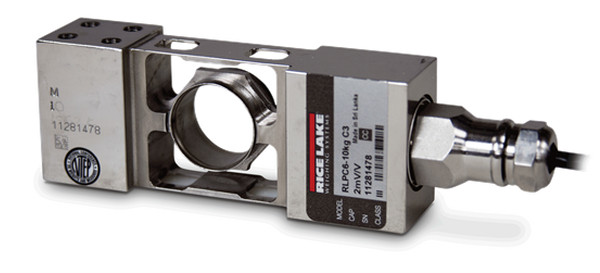
If a scale were a human body, then the load cells would be most like sensory neurons. They’re triggered by physical inputs from the environment (i.e., the force of the object being measured) and then convert that input into a message to send off to the brain for interpretation and response.
How Does a Load Cell Work?
Load cells work by converting a specific type of mechanical force like tension, torque, or compression into an output signal. This output signal is then transmitted via the load cell cable connected to the indicator where the weight can be read by the operator. The numbers you read on the display are a result of what the load cell is "feeling" from the load being applied to it.
There is a bit more to unpack, so let’s go ahead and dive into the inner workings of a load cell to hopefully shed some light on what all that means.
The Basic Principle Behind Load Cells
At the heart of every load cell is a simple relationship:
- A material bends or stretches when a load is applied (force)
- A component measuring the material’s deformation (bending or stretching)
The load cell converts that deformation into an electrical signal, which can then be translated into a force or weight reading. In other words, a load cell turns nearly invisible mechanical movements into meaningful numbers. It is what you and I see on the digital indicator displayed in pounds, ounces, grams or any other unit of measurement.
What’s Inside a Load Cell
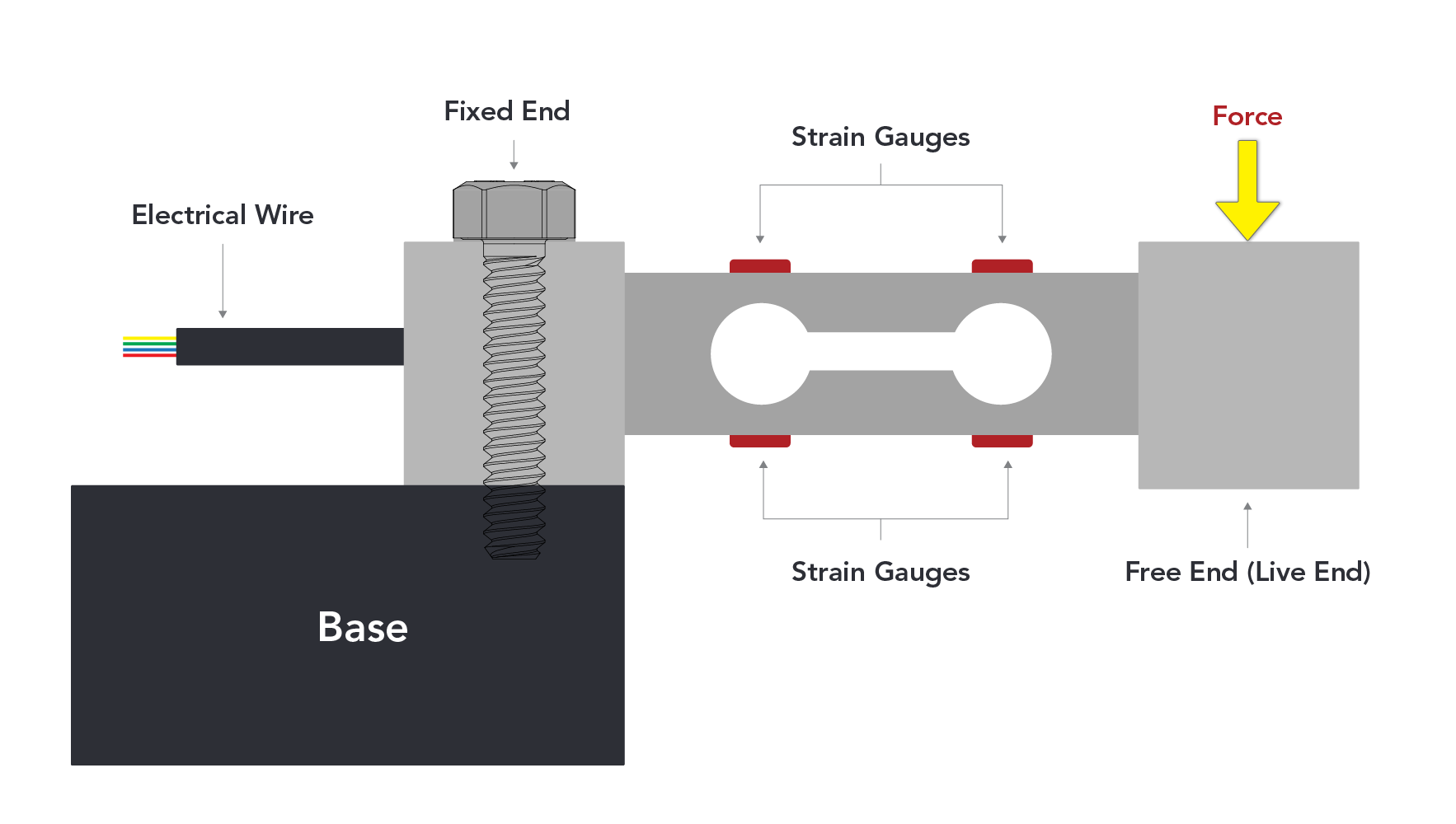
1. Spring Element (the body)
This is the metal structure that actually deforms when force is applied. Manufacturers often use stainless steel, alloy steel, or aluminum because these materials are strong yet slightly elastic. As long as the cell isn’t overloaded, these materials all return to their original shape when the load is removed.
2. Strain Gauges
Strain gauges are extremely thin, zigzag-patterned conductors bonded onto the spring element. When the metal bends, the strain gauges stretch or compress with it. Even though the movement is microscopic, the strain gauge’s electrical resistance changes enough to measure.
Strain gauges work because of a simple electrical principle:
- Stretching the gauge makes it longer and thinner, increasing its electrical resistance.
- Compressing the gauge makes it shorter and thicker, decreasing its resistance.
To picture what’s happening inside a load cell, think of a fishing rod. When a fish pulls on the line, the rod bends. A bigger fish creates a deeper bend. A load cell behaves the same way, but the flex is incredibly subtle. Strain gauges act like sensitive observers, picking up tiny distortions and transforming them into measurable electrical signals.
This combination of mechanical bending and electrical feedback is what powers the entire device. Because these changes are tiny, one strain gauge alone isn’t enough to produce a strong signal. That’s where the Wheatstone bridge comes in.
3. The Wheatstone Bridge
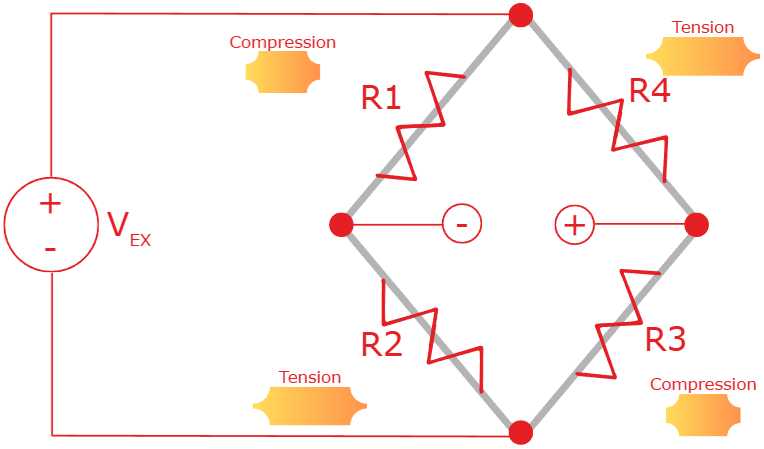
To amplify the strain gauge’s resistance changes, load cells use a Wheatstone bridge. A Wheatstone bridge is an electrical circuit made of four resistors arranged in a diamond shape. In a load cell, these resistors are the strain gauges.
When force, tension or compression is applied:
- The resistance of one or more gauges changes
- The bridge becomes out of balance
- The difference in voltage becomes measurable and appears at the output
This output voltage is proportional to the applied load. The beauty of the Wheatstone bridge is its sensitivity. It can detect extremely small changes, allowing load cells to measure with the precision of just grams, and up to hundreds of tons.
4. Turning Voltage Into What You See
The voltage that comes out of a load cell is incredibly small, often just a few millivolts. To make it usable, the signal passes through electronics that:
- Amplify the voltage: Load cells produce a small analog voltage (millivolts), a signal too small to be read by most devices. The load cell amplifies and conditions the signal to boost it into a higher, more usable level.
- Filter out noise: While the volage is being conditioned, the amplifiers help reduce the noise and improve resolution.
- Convert the signal into digital data: After amplification, the analog voltage is converted into a digital value for a computer to process. This is done using ADC (analog-to-digital converter), which is often built into modern signal conditioners. The ADC assigns a specific digital number to each voltage.
Only after this conversion can controllers, displays, or software interpret the signal as a weight or force value.
Why Do Load Cells Work So Well?
Although the principles of load cells are quite simple, they really are brilliantly designed. There are several key reasons they work so well:
- Durable and reliable: They are made from strong metals like aluminum, steel and stainless steel. They're built to withstand repetitive loads, providing a long service life as long as they are maintained.
- Maintain structural integrity: Load cells rely on elastic deformation, flexing only slightly and returning to their original shape. They maintain their structural integrity as long as they aren't overloaded or damaged.
- Linear and repeatable: Same force = same output. Over and over and over again. Load cells are very repeatable in their performance.
- Decades of design improvements: Manufacturers have been improving the design of load cells through advances in technology and material sciences for decades.
What Can Affect Load Cell Performance?
Even though load cells are designed for reliability, certain conditions can influence their accuracy. Just like any instrument or electronic device, load cells should be installed and used in accordance with the manufacturer's specifications.
Generally speaking, these are factors that can influence their performance:
- Incorrect mounting, misalignment or connection to indicator
- Excessive side loads or twisting forces
- Overloading beyond capacity
- Moisture, corrosion or debris build-up
- Temperature fluctuations or extreme hot or cold conditions
- Electrical interference (lightning, power surges, etc)
What to Learn More?
Do you want to learn more about load cells? Check out our Ultimate Load Cell Guide that we put together with our trusted partners and load cell experts at Anyload!
A Leading Load Cell Distributor
Scales Plus is a leading distributor of load cells. Our catalog includes thousands of models from many of today's most trusted manufacturers. We can help you find the right solution for your weighing needs.